Sign up now for our brand new MICEpoint website, the home of the worldwide meetings industry.
Simply go to www.micepoint.com
See you soon!
Showing posts with label MICE ideas. Show all posts
Friday, January 08, 2016
Saturday, October 11, 2014
Top 10 of unusal Hotels (according to trivago.de)
Interesting list of 10 really special Hotels.
10. Ariau Amazon Towers (Manaus, Brasilien)
9. Hotel Jumbo Stay Hostel (Stockholm, Schweden)
8. Hotel Igloo Village (Kakslauttanen, Finnland)
7.Hotel Luna Salada (Uyuni,Bolivien)
6. Hotel The Queen Mary (Kalifornien, USA)
5. Hotel Crowne Plaza (Indianapolis, USA)
4.Hotel Malmaison Oxford (Oxford, Großbritannien)
3. Martin’s Patershof (Mechelen, Belgien)
2. Hotel Cappadocia Cave Suites (Göreme, Türkei)
1. Hotel Quinta Real Zacatecas (Mexiko)
The article is in German but your browser will translate it into English :)
http://checkin.trivago.de/2013/03/20/die-top-10-der-ungewohnlichen-hotels/
10. Ariau Amazon Towers (Manaus, Brasilien)
9. Hotel Jumbo Stay Hostel (Stockholm, Schweden)
8. Hotel Igloo Village (Kakslauttanen, Finnland)
7.Hotel Luna Salada (Uyuni,Bolivien)
6. Hotel The Queen Mary (Kalifornien, USA)
5. Hotel Crowne Plaza (Indianapolis, USA)
4.Hotel Malmaison Oxford (Oxford, Großbritannien)
3. Martin’s Patershof (Mechelen, Belgien)
2. Hotel Cappadocia Cave Suites (Göreme, Türkei)
1. Hotel Quinta Real Zacatecas (Mexiko)
The article is in German but your browser will translate it into English :)
http://checkin.trivago.de/2013/03/20/die-top-10-der-ungewohnlichen-hotels/
Saturday, March 15, 2014
Wearable/Ultra-portable Computers for Events
This article comes from my friend Corbin Ball.
A new category of computers, wearable computers, are miniature electronic devices that are worn under, with or on top of clothing. …and they may be coming to an event near you!
Technology has developed in ten-year cycles: 1960s: mainframe computing, 1970s: mini-computing, 1980s: personal computing, 1990s: desktop internet computing, 2000s: mobile internet computing. This decade may turn out to be the decade of wearable/everywhere computing. Computers are popping up in our cars, our home appliances, and soon on our bodies. Most of us are already carrying around powerful computers in our pockets (smart phones), but this is just the first step.
Google Glass, smart watches, NFC rings, smart bracelets, and smart clothing are just some of the options becoming available. This will impact events and tradeshows in the next few years as attendees literally embody these devices to assist them at events.
Consider the possibilities as these technologies evolve:
Google Glass is a wearable computer with and optical head-mounted display. Light (about 1/10 of a pound) and sleek, it is worn like glasses and will become available to the public this coming year. The extremely small display, through very clever optics, appears like a 20 inch screen floating about 6 feet away. Sound is provided through bone conduction, so no ear phones are needed. It is essentially a voice and touch activated multi-media computer, GPS system, still camera, video camera, and like much more as developers continue to evolve it.
Here are some of the future possibilities for GoogleGlass for events:
- Step-by-step navigation throughout a meeting venue or an exhibit hall with visual and/or audio directions.
- Real-time video conferencing.
- Note taking (video with sound and still picture recording on voice or touch demand).
- Displaying speaker presentation notes and slides.
- Networking facilitation through taking a picture of who you meet or face recognition reminders the next time you meet them.
- Gaming applications
- Mini-teleprompters for speakers
- Sight inspection facilitation to easily record meeting spaces
- Social media interaction using video, geo-location and networking apps
For those that my think wearing a computer on your face is too geeky, no matter how sleek it may be, smart watches and bracelets also hold promise. Today, most smart watches are smart phone interfaces, and most smart bracelets/bands such as Jawbone or Fitbit are activity trackers. However, as computer processors continue to get smaller, cheaper and more powerful, these devices have the potential to have a big impact on events.
Some future options include:
- Instant business contact exchange (just tap your watches, band or NFC ring together)
- Continuing education tracking (just tap your watch, band or ring to a tag outside the room).
- Information collection at exhibit booths.
- Couse notes distribution
- Navigational assistance (indoor GPS on your watch)
- Networking (your watch or band will light up or vibrate when people of like interest come into range)
- Appointment reminder notices
- Photos, video and still of event activities and education
- Note taking
Although still in its infancy, the rapid rate of development holds the promise to make wearable computers indispensable personal assistants in multiple was as people navigate and make the most of attending events.
Corbin Ball, CMP, CSP is a speaker and independent third-party consultant focusing on meetings technology. With 20 years of experience running international citywide technology meetings, he now helps clients worldwide use technology to save time and improve productivity He can be contacted at his extensive web site: Corbin Ball Associates – Meetings Technology Headquarters and followed at www.twitter.com/corbinball
Labels:
MICE ideas,
MICE industry info,
Special features
Sunday, March 09, 2014
How to Boost Traffic at Your Trade Show Booth
Want to stand out? Plan ahead and skip the tchotchkes and gimmicks.
Clowns, costumes, caricaturists: they're staples of nearly every trade show, attempting to bring an audience to an otherwise lackluster booth. And don't forget the beguiling ladies, handing out fliers with a side of flirtation. Does any of the showiness of the showroom floor actually work to draw in attendees that become reliable leads?"Don't get me started on booth babes," said Susan Friedmann, an industry consultant who goes by "The Tradeshow Coach." "People really have had to get more serious about exhibiting. When you're investing often several hundred thousand dollars going to a trade show, you have to get a return on your investment."
Whether your desired outcome is to fill a spreadsheet with sales leads, generate buzz for a new product, or just increase brand awareness, relying on random booth traffic isn't usually the wisest strategy, experts tell Inc. Plan early for not just creating an inventive and effective booth, but also for getting the right people to seek you out."A lot of show marketers leave it to the show organizer to drive traffic on the show floor," said Ruth P. Stevens, a consultant on business-to-business marketing and president of eMarketing Strategy. "You cannot cede responsibility to the show organizer to get all the traffic you want to get – you need to take aggressive action."
Drawing Traffic to Your Trade Show Booth: Plan Ahead
Trade show consultants and experts cite a statistic illustrative of the risk of leaving convention or show traffic to chance: Roughly 70 percent of show attendees plan a list of whom they're going to visit before ever entering the convention center doors. They say that number makes plain the power – and necessity – of pre-show outreach.Stevens advocates taking a two-pronged approach. The first would be to contact your in-house file – that's your regular customers, local contacts, and solid prospects. The other? Registered attendees of the show. "Most organizers, if you are buying a booth, will give you access to this list," Stevens says. "You should conduct some outreach to them - or a segment of attendees that might be interested in you - either through direct mail, e-mail, or even phone."
While e-mailing a contact list is by far the most cost-effective way to spread information about an upcoming trade show or conference appearance, David Brull, the vice president of marketing and membership for the Trade Show Exhibitors Association, says snail mail not only still works, but might be the best means of communicating an upcoming event. "A postcard is pretty much the most effective – and odd sized is even better so that it doesn't just blend in and end up in the trash. I know one person that shaped theirs like a fish once, and that really brought people in."
While you're at it, make a substantial effort to contact and make appointments with your local clients, suppliers, or anyone you do business with in the geographic area of your show. It's a simple way to get face-time with folks you might not otherwise be able to sit down with – and a way to make sure you or your employees aren't wasting time standing around in an empty booth.
Drawing Traffic to Your Trade Show Booth: Offer an Incentive, But Be Selective
Getting a piece of mail into a potential client's hand isn't enough, though, Stevens says. They'll also need a solid reason to show up. If you have a new product launching – especially if there's at least an aspect of it that will be completely fresh to consumers – promote that."Or, if you don't have something new, you might want to make a special offer," Stevens says. "It might be a price promotion, or a show discount, or you might want to give them a special gift for coming by."
But, there's a big difference in having special gifts for the people you've contacted before the show and doing a random promotion to draw foot traffic into your booth, Friedmann says. "You have to give your target audience a reason to come and see you, based on your goals and objective," she says. "I'm not an advocate of just giving away an iPad or a camcorder, because you're not attracting someone in your target audience."
That's because the old put-your-business-card-in-a-fishbowl-and-win-a-prize ruse to generate leads has proven itself stale.
"Putting a bowl out and asking people to drop in a business card is a waste of energy," Stevens says. "The real way to generate good leads is to have a conversation and kick off a business relationship. You can rent cold names for 15 cents each, so why would you spend hundreds at a trade show to get cold names?"
And the value of pricey giveaways can be lost if your company doesn't get quality warm leads out of the very thing that's supposed to draw people to your booth.
"You have to know your attendees," Stevens says. "If there are going to be a lot of unqualified people, like students or spouses, know that. If it's going to be prowled by a lot of tchotchke grabbers, you might want to keep the gift under the table."
There are other ways to bond with your target audience at a trade show. Friedmann suggests hosting events away from the trade show floor, in more private conference rooms. Reserve space ahead of time, she suggests, and use it for special product demos that you might not want your competition to be privy to – but that you do want your best customers to see.
Another option is to speak on a panel. Talk early on with the conference or trade show's organizers about possible topics that you and your company are experts in – or even a niche of a current industry trend. Being in the middle of the debate or on the edge of innovation, explaining it as you go, is a great place to be. The bonus: You'll be sure to attract those most interested in your work. Offer them additional conversation, a free book, or something else useful, if they'll stop by your booth later.
Be sure to let your clients – and future customers – know where you are speaking and what special events your company is participating in over social media. Increasingly, conferences create their own Twitter hash-tag, so participants can communicate with one another from the showroom floor.
"Individual show exhibitors are using twitter too – saying, hey, I just sold my first widget, or I just attended a great talk," Stephens says. "A lot of them are gaining more attention for their booth by just tweeting around."
Drawing Traffic to Your Trade Show Booth: Be Aggressive, Not Abrasive
If you're debuting a product, and actually want a lot of general buzz and interest in your product and brand, the golden rule is: "If you have a product people can play with, make sure you can bring it," Brull says. "The whole point of face-to-face marketing is so people can touch and feel things."For small companies with small booths, just remember that for every 10' by 10' booth you have, you have approximately four seconds to engage someone that's walking by. And distractions are aplenty: "The trade show environment is easy to get overwhelmed, it's easy to go into this zombified state and it's so easy to not be able to take anything in," Friedmann says.
Brull suggests to draw in people, create a clean, warm environment they can step into. "In some way, it's your retail store. You need to think of it as your home for a few days, and inviting people into your space should be pleasant," he says.
Having the right people in your booth can also make or break the quick impression your company makes on passers by. For the weekend, remember, the employees in your booth are your ambassadors. While Friedmann says they should never hawk to people from the aisles, they shouldn't be hidden behind a table. They should ask engaging questions off the bat to find out in a non-intrusive way whether the person stopping by is a potential customer or business partner – or just might be curious about your brand.
David Maskin makes a living drawing people into trade show booths. He creates personalized nameplates by bending aluminum wire as giveaways from the company who takes him on to sit in their booth. While Maskin – who goes by "The WireMan" – markets himself as a traffic magnet, he tries to go beyond collecting business cards and creating cold leads.
"The way I like to do things is to go beyond just drawing people into a booth. The big word free is one way to get people to come in. Others will come in just to see what I'm doing," Maskin says. "And when one person comes in, their colleagues come and stand around, which gives the booth staff time to come and mingle with the crowd."
Stevens says: "To me the most important thing to keep in mind is quality. It's really easy to waste a lot of money on a show – it's an expensive environment on a cost-per-contact basis. You want to make sure you're attracting and talking to people who are really likely to be buyers or influencers in your world."
Drawing Traffic to Your Trade Show Booth: Look Sharp
It's not just the shiny things inside your booth that can be a draw for attendees. The booth itself can attract visitors.Aside from the open, warm, retail-style aesthetic Brull suggests, you'll want to make sure you don't box in too much of your space with tables or displays. "You don't want to block your door with a table," he says.
This year's Exhibitor magazine exhibit design awards hailed mostly booths that created a calm sanctuary in an otherwise chaotic exhibit atmosphere. And doing something that stands out doesn't have to be expensive. Autodesk Inc. won an exhibitor award for creating an 18-foot-high double archway or cardboard tubing that soared above its and custom-made walls and desks. The cost? Thirteen dollars per square foot.
"One of the most effective booths I've ever seen was a 10' by 20' booth with a back wall of boxes or all colors and shapes," Brull says. It was for a box-shipping company. "It was neat, and eye-catching, but it wasn't expensive."
That said, design options can be pretty restricted when you only have a 10' by 10' or 15' booth.
"The most important thing in booth design in a small booth – or any booth really – is the signage," Stevens says. "Assuming you've done your work in pre-show promotions, you want to attract the people who know you."
The way to attract them, Stevens says, is with a "benefit-oriented" sign. It should:
- Be visible and legible from down an aisle on the showroom floor
- Have words that give a potential client a good reason to stop.
- Answer the question for a client: What's in it specifically for me?
- Not use a lot of jargon, such as "exceptional interface."
- Include a solution to a business problem.
Don't be afraid to be specific – turning off a segment of the trade show audience who isn't your target is just fine.
"If you're offering specific software for accountants, say so," Stevens says. "You do in fact want to repel unqualified prospects. The real value of show exhibiting is to develop valuable contacts with people you might do business with, and you only have x number of hours to do that."
Read the full article here on Inc.
Labels:
MICE ideas,
MICE industry info,
MICE Trade fairs
Saturday, March 08, 2014
4 Tips for Training Event Staff
When guests walk through the door to your event, it’s your event staffers who will ensure that they experience the event as you’ve planned and envisioned it. Are they up to the task? Help them offer flawless service with these four training best practices.
And if you can, literally walk the venue as different guests would. Knowing, in detail, how they will flow through an event can help you prepare volunteers and station them where you predict confusion.
You’re an event planner. You know that there is no amount of signage or advance information that will prevent guests from asking questions. Prepare your volunteers or staff with a list of responses to frequently asked questions. These might include queries about food allergies, coat check, restrooms, the business center, or other issues. If necessary, coach them about how to handle a registered guest who brings unregistered friends to a limited-seating event.
For cases that can’t be anticipated or otherwise need your attention, make sure your staff knows how to get in touch with you. They don’t need to have all the answers, but they should be able to quickly find them. Confident staff will ensure a positive experience for every guest, even those who require special consideration.
If prior training is impractical, consider printing a “cheat sheet” that briefly explains what’s required and covers any frequently asked questions. E-mail the checklist to volunteers before the event so they can look it over on their own.
They represent you during the execution of the event and will be most effective if they’re happy to be there. Besides, a positive experience will make them more likely to volunteer at an event in the future and could save you the trouble of recruiting and re-teaching inexperienced staff.
Recognize your staff as your greatest support in the execution of the event and acknowledge them with thanks before, during, and after an event. They’ll show their gratitude with their performance.
Drew D’Agostino is CTO and cofounder of Attendware, online software that simplifies and automates event management processes. The company is backed by .406 Ventures and is headquartered in Boston, Mass. Prior to founding Attendware, D’Agostino served as a contracted CTO for several startup companies, was a member of the product team at Gemvara, and was director of business development at Jola Venture, a funded startup that launched a sustainable food-preservation technology in Cameroon, Africa.
Full article can be found on meetingsnet.com
1. Role-play your event as a guest.
The difference between a good event and a great event is attention to detail. How should arriving VIPs or speakers be greeted and managed? Should pre-registrants be processed in a different line from on-site registrants? You know how to handle these “simple” situations instinctively, but don’t assume that your volunteers or local staff share your hard-learned skills. Role-playing, where you take on the persona of different types of guests, gives you an opportunity to show your volunteers how to properly attend to all of them.And if you can, literally walk the venue as different guests would. Knowing, in detail, how they will flow through an event can help you prepare volunteers and station them where you predict confusion.
2. Prepare your staff for FAQs.
You’re an event planner. You know that there is no amount of signage or advance information that will prevent guests from asking questions. Prepare your volunteers or staff with a list of responses to frequently asked questions. These might include queries about food allergies, coat check, restrooms, the business center, or other issues. If necessary, coach them about how to handle a registered guest who brings unregistered friends to a limited-seating event.For cases that can’t be anticipated or otherwise need your attention, make sure your staff knows how to get in touch with you. They don’t need to have all the answers, but they should be able to quickly find them. Confident staff will ensure a positive experience for every guest, even those who require special consideration.
3. Allow enough time for training.
Training an hour before an event leaves little time for staff to internalize your instructions. Consider holding a training session at least a few hours—if not days—prior to the event. Make it more appealing by offering free food or organizing an outing after. The more excited staff are about the event, the more enthusiastic they will be when helping your guests.If prior training is impractical, consider printing a “cheat sheet” that briefly explains what’s required and covers any frequently asked questions. E-mail the checklist to volunteers before the event so they can look it over on their own.
4. Thank them, and then thank them again.
Have you ever worked for a boss that didn’t appreciate your efforts? Don’t be that boss. If you make your volunteers feel like they are a crucial part of the team, they are way more likely to adopt your goal of event success.They represent you during the execution of the event and will be most effective if they’re happy to be there. Besides, a positive experience will make them more likely to volunteer at an event in the future and could save you the trouble of recruiting and re-teaching inexperienced staff.
Recognize your staff as your greatest support in the execution of the event and acknowledge them with thanks before, during, and after an event. They’ll show their gratitude with their performance.
Drew D’Agostino is CTO and cofounder of Attendware, online software that simplifies and automates event management processes. The company is backed by .406 Ventures and is headquartered in Boston, Mass. Prior to founding Attendware, D’Agostino served as a contracted CTO for several startup companies, was a member of the product team at Gemvara, and was director of business development at Jola Venture, a funded startup that launched a sustainable food-preservation technology in Cameroon, Africa.
Full article can be found on meetingsnet.com
Labels:
MICE ideas,
MICE industry info,
MICE Trade fairs
Friday, March 07, 2014
Splash, The Party Scientists Stealing Big Business From Eventbrite
People don’t want ads, they want memories. To shift from spammy marketing to providing experiences, companies like Anheuser-Busch, Spotify, NPR, and Wired promoted 80,000 events in 2013 with a little startup called Splash. In co-founder Ben Hindman’s first in-depth interview, he tells how Splash’s event platform is challenging bland incumbents with its beautifully designed party websites.
A hundred years ago, big events like the World’s Fair were announced with bold, artistic posters. That was the only way to catch someone’s eye on the street. Yet somehow, the Web 2.0 era sucked the life out of event promotion. In the name of consistency, Eventbrite and Facebook caged events in uninspired templates. But if you’re throwing a big event, why would you want it to look like everyone else’s?
“I have been obsessed with the power of the live event since I can remember,” Hindman tells me. He believes the invitation website isn’t just an event’s first impression — it’s where the party starts and ends. It needs to be as unique and vibrant as the experience itself and should host memories of the moment afterwards.
As a founding member of invite-only getaway conference Summit Series and director of events at city guide site Thrillist, Hindman was charged with luring people out of their homes. Meanwhile, he noticed brands were having great success growing and delighting their customer bases through events. That’s when he had the idea for Splash, a way for anyone to build a gorgeous event website, manage attendees, and create a gallery of photos, videos, and other social media from the shindig.
It’s free to set up and host event sites on Splash. Users get full control of the background, fonts and color schemes, as well as where functional elements like talent bios, RSVP buttons, and ticket sales go. Attendees can check in on mobile when they arrive, and organizers can project a Splash-aggregated real-time stream of photos taken at the event and view analytics afterwards. Paid, à la carte Pro services include more customization, design assistance, email marketing, and on-demand support, because when it’s day-of-show, promoters need immediate help to save their sanity if something goes wrong. Splash’s “Hall Of Fame” of great event pages shows off what it can do.
In the two years since, Splash has stayed quiet refining its product despite explosive growth. The 80,000 event sites it hosted in 2013 drew 1.6 million attendees, and Splash processed $3.5 million in ticket sales. Through the 2% + $0.99 it charges for-profit companies to sell tickets processed through Braintree, it brought in $100,000 in revenue. That ticket fee is just a little lower than Eventbrite’s.
In 2014, Splash is expecting 5X that revenue. In fact it’s already booked $300,000 in revenue this year thanks to big enterprise deals with frequent event throwers like Anheuser-Busch, which is planning 60,000 events on Splash this year for its products like Budweiser beer. Facebook is even using Splash instead of its own events platform to promote parties at SXSW and developer meet-ups around the world. That’s a pretty solid endorsement.
On the back of this momentum, the 12-person startup just closed a $1.5 million seed round from Maveron, Lerer Ventures, David Tisch’s BoxGroup, PROfounders, Red Sea Ventures, Great Oaks, and angels like Scott Belsky of Behance, former Facebook sales director Kevin Colleran, Hot Topic’s Eben Pagan, and Thrillist’s Jody Rones. That builds on the $240,000 convertible note it raised from BoxGroup in 2013.
Splash still has a long way to go before becoming a household name like Eventbrite, which is rocketing towards an IPO. It’s also competing in some ways with MailChimp on email marketing and NationBuilder for political events. But while Splash does sell tickets, its focus is more on free-to-attend branded events. That’s where the real opportunity is — companies with big budgets trying to make a big…splash. With great design, even something as low-key as a “public policy happy hour” can seem exciting.
Read the full article here: Techcrunch
A hundred years ago, big events like the World’s Fair were announced with bold, artistic posters. That was the only way to catch someone’s eye on the street. Yet somehow, the Web 2.0 era sucked the life out of event promotion. In the name of consistency, Eventbrite and Facebook caged events in uninspired templates. But if you’re throwing a big event, why would you want it to look like everyone else’s?
“I have been obsessed with the power of the live event since I can remember,” Hindman tells me. He believes the invitation website isn’t just an event’s first impression — it’s where the party starts and ends. It needs to be as unique and vibrant as the experience itself and should host memories of the moment afterwards.
As a founding member of invite-only getaway conference Summit Series and director of events at city guide site Thrillist, Hindman was charged with luring people out of their homes. Meanwhile, he noticed brands were having great success growing and delighting their customer bases through events. That’s when he had the idea for Splash, a way for anyone to build a gorgeous event website, manage attendees, and create a gallery of photos, videos, and other social media from the shindig.
It’s free to set up and host event sites on Splash. Users get full control of the background, fonts and color schemes, as well as where functional elements like talent bios, RSVP buttons, and ticket sales go. Attendees can check in on mobile when they arrive, and organizers can project a Splash-aggregated real-time stream of photos taken at the event and view analytics afterwards. Paid, à la carte Pro services include more customization, design assistance, email marketing, and on-demand support, because when it’s day-of-show, promoters need immediate help to save their sanity if something goes wrong. Splash’s “Hall Of Fame” of great event pages shows off what it can do.
In 2014, Splash is expecting 5X that revenue. In fact it’s already booked $300,000 in revenue this year thanks to big enterprise deals with frequent event throwers like Anheuser-Busch, which is planning 60,000 events on Splash this year for its products like Budweiser beer. Facebook is even using Splash instead of its own events platform to promote parties at SXSW and developer meet-ups around the world. That’s a pretty solid endorsement.
On the back of this momentum, the 12-person startup just closed a $1.5 million seed round from Maveron, Lerer Ventures, David Tisch’s BoxGroup, PROfounders, Red Sea Ventures, Great Oaks, and angels like Scott Belsky of Behance, former Facebook sales director Kevin Colleran, Hot Topic’s Eben Pagan, and Thrillist’s Jody Rones. That builds on the $240,000 convertible note it raised from BoxGroup in 2013.
Splash still has a long way to go before becoming a household name like Eventbrite, which is rocketing towards an IPO. It’s also competing in some ways with MailChimp on email marketing and NationBuilder for political events. But while Splash does sell tickets, its focus is more on free-to-attend branded events. That’s where the real opportunity is — companies with big budgets trying to make a big…splash. With great design, even something as low-key as a “public policy happy hour” can seem exciting.
Read the full article here: Techcrunch
Labels:
MICE ideas,
MICE industry info,
Special features
Friday, January 10, 2014
How You Can Choose the Perfect Music for your Meeting
Here is how to decide what music to play in your Meeting or Conference to help with brain-based learning. While you could use an endless number of criteria, these are a good start. I recommend using an iPod with a Bose Sound Dock player. You get the best of all worlds.
1) State. What emotional state are you trying to elicit? Pay attention to what happens to your own body and mind as you listen to a song. Pay attention to the beats per minute (BPM). Songs in the 35- 50 BPM range will be more calming, while those in the middle 55-70 BPM will be more moderate for seatwork. For activities, the pace might be 70-100 and for energizers, maybe 100-160 BPM will REALLY rev it up.
The state is also the feelings you want to have within your participants. When participants complete an assignment, project or even a simple task, I want upbeat celebration music. When we are doing a class stretching or reflective writing, I want slower, uncluttered, calming music. When we are about to start out on a big task, I want inspirational, upbeat, even marching music. In short, use music as a second teacher in the classroom to support the mood.
2) Age of Listener. What generation am I working with? Stay within your generation! The way to decide is ask this simple question: If they’re adults, what music did they listen to in high school and college? If they’re age 14 or less, what are the current soundtracks to movies that are hot?
3) Type of Music. Do I use music with words or instrumentals only? In general, use words only if it’s for transitions, games that require them or special occasions. Most of the time, instrumentals are better. If you use only one kind of music you’re missing out on some great alternatives.
Read the full article here:
Eric Jensen Brain-Based Learning
1) State. What emotional state are you trying to elicit? Pay attention to what happens to your own body and mind as you listen to a song. Pay attention to the beats per minute (BPM). Songs in the 35- 50 BPM range will be more calming, while those in the middle 55-70 BPM will be more moderate for seatwork. For activities, the pace might be 70-100 and for energizers, maybe 100-160 BPM will REALLY rev it up.
The state is also the feelings you want to have within your participants. When participants complete an assignment, project or even a simple task, I want upbeat celebration music. When we are doing a class stretching or reflective writing, I want slower, uncluttered, calming music. When we are about to start out on a big task, I want inspirational, upbeat, even marching music. In short, use music as a second teacher in the classroom to support the mood.
2) Age of Listener. What generation am I working with? Stay within your generation! The way to decide is ask this simple question: If they’re adults, what music did they listen to in high school and college? If they’re age 14 or less, what are the current soundtracks to movies that are hot?
3) Type of Music. Do I use music with words or instrumentals only? In general, use words only if it’s for transitions, games that require them or special occasions. Most of the time, instrumentals are better. If you use only one kind of music you’re missing out on some great alternatives.
Read the full article here:
Eric Jensen Brain-Based Learning
Labels:
MICE ideas,
MICE industry info
Marriott Invests in Technology; Launches New Program for Meeting Planners
Yesterday, Marriott Hotels launched Meetings Imagined, a new program that aims to help meeting planners and hotel staff collaborate on event creation. Using an online platform, MeetingsImagined.com shares tips, trends, and images described as “inspirational” to spark creativity. Through the website, customers can collaborate with hotels to design custom events or view programs featured at the participating test hotels, as well as share images on social media sites, such as Pinterest and Facebook.
The site has images of experiences Marriott has hosted around the world as well as event tips such as icebreakers, food and music to set the mood. (“Tip: Create plenty of breaks throughout the day. Research shows that the brain focuses better with several short breaks rather than a few long ones.”) Planners can tailor food and beverage, setup, technology and experiences based on the ultimate goals of each meeting, to design more inspiring and engaging experience for attendees.
“Attendees and planners are looking to be inspired,” Andrew Moffett, senior director of event management for Marriott, told International Meetings Review. “They’re looking for resources to go to and finding different ways to set up and execute meetings based on their needs. We’ve categorized what these look like for planners. They can go online and look through a library of photos to gain inspiration.”
The concept is the result of research that found key shifts in how planners work collaboratively and use technology. After speaking with next generation customers and analyzing more than 40,000 meetings hosted at Marriott’s hotels each year, the research team determined seven purposes for meetings: celebrate, decide, educate, ideate, network, produce and promote.
“We know every meeting has a purpose,” Moffett said. If a planner is looking to hold a training class, for example, the planner and a hotel’s event manager can collaborate through the Meetings Imagined program to create the right kind of environment that would promote higher learning engagement and retention. “We’re looking to co-create this with our customers who bring us meetings and the hotels that have been selected.”
Five Marriott hotels within the U.S. will test the new concept, including the Chicago Marriott O’Hare, Tysons Corner Marriott, Gaithersburg Marriott Washingtonian Center, Orlando World Center Marriott, and the Atlanta Marriott Marquis. The concept is also available in Europe at the London Marriott Grosvenor Square, Paris Marriott Rive Gauche, Munich Marriott Hotel and the Amsterdam Marriott Hotel and will expand to more Marriott Hotels in 2014.
See the full article on
International Meetings Review
The site has images of experiences Marriott has hosted around the world as well as event tips such as icebreakers, food and music to set the mood. (“Tip: Create plenty of breaks throughout the day. Research shows that the brain focuses better with several short breaks rather than a few long ones.”) Planners can tailor food and beverage, setup, technology and experiences based on the ultimate goals of each meeting, to design more inspiring and engaging experience for attendees.
“Attendees and planners are looking to be inspired,” Andrew Moffett, senior director of event management for Marriott, told International Meetings Review. “They’re looking for resources to go to and finding different ways to set up and execute meetings based on their needs. We’ve categorized what these look like for planners. They can go online and look through a library of photos to gain inspiration.”
The concept is the result of research that found key shifts in how planners work collaboratively and use technology. After speaking with next generation customers and analyzing more than 40,000 meetings hosted at Marriott’s hotels each year, the research team determined seven purposes for meetings: celebrate, decide, educate, ideate, network, produce and promote.
“We know every meeting has a purpose,” Moffett said. If a planner is looking to hold a training class, for example, the planner and a hotel’s event manager can collaborate through the Meetings Imagined program to create the right kind of environment that would promote higher learning engagement and retention. “We’re looking to co-create this with our customers who bring us meetings and the hotels that have been selected.”
Five Marriott hotels within the U.S. will test the new concept, including the Chicago Marriott O’Hare, Tysons Corner Marriott, Gaithersburg Marriott Washingtonian Center, Orlando World Center Marriott, and the Atlanta Marriott Marquis. The concept is also available in Europe at the London Marriott Grosvenor Square, Paris Marriott Rive Gauche, Munich Marriott Hotel and the Amsterdam Marriott Hotel and will expand to more Marriott Hotels in 2014.
See the full article on
International Meetings Review
Labels:
MICE ideas,
MICE industry info
Tuesday, December 24, 2013
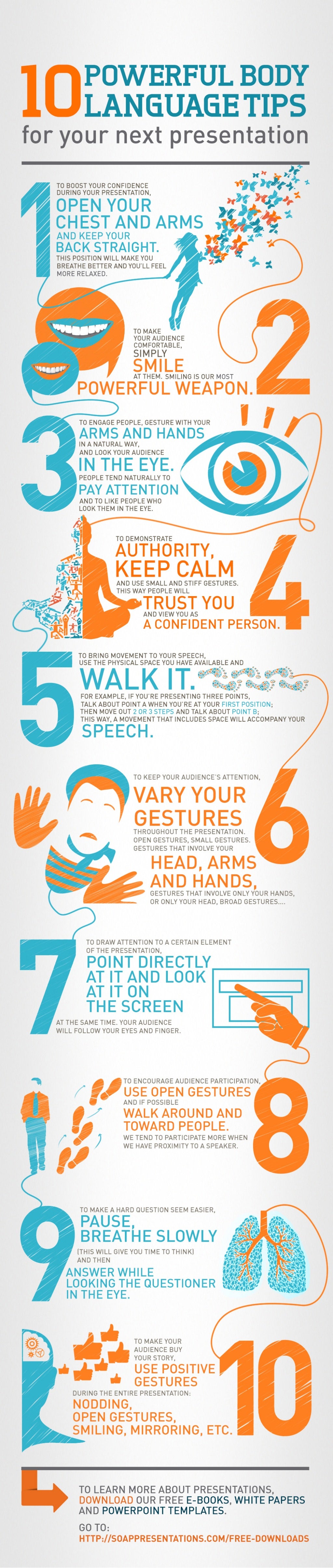
10 Body Language Tips Every Speaker Must Know
We all know that when we give a presentation or speak in front of a group, not only are our words important, but the body language that accompanies them.
Your words may give the audience one message while your body sends quite another.
As if getting the words out wasn't hard enough, right?
An infographic from SOAP Presentations lists 10 body language tips to employ during your next presentation. These tips range from how to get the audience to like you, to how to make sure the audience remembers your key points.
For example:
1. To get the audience to like you, make eye contact. People tend to pay more attention to and like those who look them in the eye.
2. To boost your confidence, open your chest and arms, and keep your back straight.
3. To demonstrate authority, be calm and use small, stiff gestures.
4. To draw the audience's attention to something, point directly at it and look at it yourself. The audience will follow your lead.
5. To convince the audience of something, use positive gestures — smiling, nodding, open movements, etc. — throughout the presentation.
Check out the full graphic for more:
Read more: http://www.entrepreneur.com/article/230253#ixzz2oNhquFjo
Your words may give the audience one message while your body sends quite another.
As if getting the words out wasn't hard enough, right?
An infographic from SOAP Presentations lists 10 body language tips to employ during your next presentation. These tips range from how to get the audience to like you, to how to make sure the audience remembers your key points.
For example:
1. To get the audience to like you, make eye contact. People tend to pay more attention to and like those who look them in the eye.
2. To boost your confidence, open your chest and arms, and keep your back straight.
3. To demonstrate authority, be calm and use small, stiff gestures.
4. To draw the audience's attention to something, point directly at it and look at it yourself. The audience will follow your lead.
5. To convince the audience of something, use positive gestures — smiling, nodding, open movements, etc. — throughout the presentation.
Check out the full graphic for more:
Read more: http://www.entrepreneur.com/article/230253#ixzz2oNhquFjo
Labels:
MICE ideas,
MICE industry info
Saturday, December 14, 2013
Yes, it is marketing but this one is great!
Just enjoy and have a Merry Christmas!
Labels:
MICE ideas,
Special features
Tuesday, August 20, 2013
A switched-on hotel in Dubai
I found an interesting article about how to use modern technology in a good and consumer friendly way,
in Dubai, the ca new Hotel called "Vida Downtown" allows you to check in, order room service from your smartphone — even if you’re poolside.
From funky tables that turn into interactive touch screens to in-room tablets that double as hotel room keys and controls for lights and temperature, the era of Jetsons-esque travel is already here.
But let’s face it. Beyond a few nods of approval at the concierge, the novelty often quickly wears out. Or, if you aren’t really part of the gadget set, you probably have given up trying to figure out your room’s technological amenities.
One hotel in Dubai wants to change all that by giving you, the guest, the power to future-forward your hotel room right from your device — meaning your smartphone or tablet becomes the control board for all the stuff you need. You can order room service, book your laundry, buy gifts, speak to a concierge or pick up an e-newspaper, all from your device.
And all this without the need to ever download an app.
Read the full article by Gulf News here:
http://gulfnews.com/life-style/travel/destinations/a-switched-on-hotel-in-dubai-1.1220636
in Dubai, the ca new Hotel called "Vida Downtown" allows you to check in, order room service from your smartphone — even if you’re poolside.
From funky tables that turn into interactive touch screens to in-room tablets that double as hotel room keys and controls for lights and temperature, the era of Jetsons-esque travel is already here.
But let’s face it. Beyond a few nods of approval at the concierge, the novelty often quickly wears out. Or, if you aren’t really part of the gadget set, you probably have given up trying to figure out your room’s technological amenities.
One hotel in Dubai wants to change all that by giving you, the guest, the power to future-forward your hotel room right from your device — meaning your smartphone or tablet becomes the control board for all the stuff you need. You can order room service, book your laundry, buy gifts, speak to a concierge or pick up an e-newspaper, all from your device.
And all this without the need to ever download an app.
Read the full article by Gulf News here:
http://gulfnews.com/life-style/travel/destinations/a-switched-on-hotel-in-dubai-1.1220636
Friday, December 16, 2011
Enter the future with the 3120 room
Experience something completely new at Novotel Paris Vaugirard. Technological innovations and new experiences are all packed into this unique room that won't last, where you can relax and rest, and be surprised too.
Click here to experience the future through photos and videos, and the chance to take part in the contest to win a weekend stay in room 3120 and lots of other exciting prizes!
Wednesday, November 16, 2011
Small encyplodia of travel errors
This is a recommendation for all German speaking readers (sorry for all others).I stumbled upon this little booklet called «Kleines Lexikon der Reise-Irrtümer» while reading a newspaper.
The german travel author Nele-Marie Brüdgam has written this lovely booklet and gave an interview to the Swiss newspaper Tagesanzeiger lately.
Frau Brüdgam, wann wurde Ihr letzter Irrtum auf einer Reise entlarvt?
Kürzlich, im September, auf meiner letzten längeren Reise: zehn Tage Malta und Gozo.
Und, welchem Irrtum sind Sie damals aufgesessen?
Es waren mindestens drei Irrtümer: Erstens: Es ist sinnvoll, auf Malta einen Englischkurs zu belegen. Englisch ist zwar die zweite Amtssprache auf Malta, aber das maltesische Englisch klingt sehr eigenartig. Zweitens: Tauchen könnte ein nettes Hobby sein. Drittens: Malta hat angenehm warmes Wetter im Herbst.
Welches ist immer noch der am weitesten verbreitete Irrtum unter Touristen?
Meinem Empfinden nach gehören zum Beispiel die folgenden Irrtümer zu den am weitesten verbreiteten: Venedig ist völlig überteuert und viel zu touristisch. Die Franzosen sprechen keine Fremdsprachen. Fliegen ist gefährlich.
Warum halten sich die so hartnäckig?
Vielleicht, weil der Mensch gern das bestätigt sieht, was er erwartet. Und weil er die Gefahr liebt.
Den Fehleinschätzungen wollen Sie nun mit Ihrem «Kleinen Lexikon der Reise-Irrtümer» beikommen. Schaffen Sie das?
Das Buch liefert den Lesern sehr viele Infos und Fakten. Was aber noch wichtiger ist: dass jeder Leser seine eigenen Vorurteile hinterfragt, mit offenen Augen und wachem Geist auf Reisen geht. Und so seine eigenen Irrtümer entlarvt.
To see the full interview please visit the Tagesanzeiger.
This interview was made by Daniel Arnet.
Labels:
MICE ideas,
MICE industry info,
Special features
Wednesday, February 02, 2011
An open letter to conference organizers by Scott Berkun

This post comes from Scott Berkun
Dear Conference Organizer:
For centuries you and your peers have helped spread good ideas. For that, I like you. Events are important and organizing them is a thankless job. I’ve run my share of events, so I know. But there is a unspoken, often forgotten, problem I’m compelled to bring to your attention: most speakers do a bad job.
Some of this is not your fault. Good speakers are hard to find, especially ones who are available, affordable, and reputable. It’s challenging to fill an afternoon with great speakers, much less a 5 day, 3 track program. But it’s commonly forgotten in your trade that speakers are the center of your event. They are the core of the agenda. They are what you advertise and what they promise to teach is why people pay to come. Yet once signed up to speak, they are often an afterthought, neglected and ignored.
There are simple and inexpensive ways to solve this problem.
1. Provide audience demographics. Make it easy for speakers to make the right assumptions about your audience. Give a sheet listing: age breakdown, job titles, gender breakdown, reasons for attending, and more. Most events have this information for marketing purposes, but rarely provide it to the speakers. This is dumb. The speakers make the product people are paying for (e.g. talks and workshops) and should be well informed about who the customers are. If nothing else providing this data reminds speakers it’s the audience that matters, not their egos.
2. Provide speaker training. There are many great books on public speaking and books are cheap. Send them to your speakers, and do it far enough in advance for it to impact their preparation. It signifies you care about their skills and want them to do their best. If even 20% of them read the book, and each avoid one basic mistake, it will pay off dramatically in higher quality sessions. Presentation Zen, which focuses on slide design, and my own book, Confessions of a Public Speaker, which covers everything else, make excellent companions. Major events and corporations hire speaker coaches, as speaking is a performance skill, but this can be expensive for large events. Books are an affordable place to start. Put this in a packet with #1, and send it out when you sign a speaker.
3. Send example videos from previous years. Talking about presenting and watching a good presenter present are different things. Give people a sense of what you, as an organizer, hope they achieve. It will also familiarize them with what attendees saw, and how they responded, in previous years.
4. Schedule a walkthrough / tech-check for each speaker. We know how fear works – unfamiliar rooms and spaces increase people’s nervousness. If you schedule a 15 minute slot early in the day, or the day before, for speakers to go to the room, try out their gear, and get comfortable, everyone wins. It’s also insurance against any compatibility issues (projectors vs. laptops), as there is nothing worse than discovering these problems in front of a live crowd. If you are not allowing speakers to use their own laptops (which is preferable), a walkthrough is extra important.
5. Have a volunteer in the room during the session. Every room should have a volunteer who can assist the speaker for any last minute needs or problems. This includes assisting with tech problems, getting water, helping with Q&A at the end and more. For a free ticket, many people will be happy to play this role, so everyone wins.
6. Provide confidence monitors in ever room. One distracting habit among many speakers is they look at their own slides, annoying the audience every time. Some of this is lack of practice, but part of the problem is room design. If you put a monitor in the front of the room, facing the speaker, so they can see their own slides while looking at the audience, everyone wins. It’s cheap to set up, has clear benefits and requires no extra work on the part of the speaker. Events like Ignite Seattle consistently do this, which helps explain why so many good talks have happened there.
7. Do not inflict a slide template on speakers. Attendees will remember where they are without an a reminder on every single slide in every single talk. Give a basic template to speakers as an option if you must, or as a head start for first time speakers, but that’s the limit of the value of slide templates. For whatever reason they tend to be ugly, confining, and just plain silly. A related suggestion: let speakers use their own laptops. Moving slide decks between computers often breaks fonts and other formatting, problems organizers rarely notice, but can be devastating to even a well prepared speaker.
8. Have a speaker’s dinner or happy hour. Have an evening early in the event where speakers can meet each other, and the organizers, and make some social connections. You want the speakers to be happy and friendly at the event, as it’s the interactions they have with your customers between sessions that are likely to be the most memorable for them. The more social you are with speakers, the more social they will be with your attendees. And some speakers are dying to meet some of the other speakers and that can only happen through you.
9. Rate your speakers and share the data. Speakers rarely get any useful feedback on how well they did. Everyone is polite and tells them they were great, even when they bombed. Most events do surveys after each session, but the data oddly never makes it to the speakers. This is broken. A simple stack ranking tells every speaker how they compared against their peers (e.g. “You were the 5th best speaker out of 10, based on audience surveys”) is a potent motivator for them to examine their skills, and to pay attention to what the better speakers did differently. Have a best session award, so everyone sees the feedback loop in action. UIE events even pays speakers a bonus that gets larger the better they scored. Shouldn’t pay be tied to performance for speakers too?
Please consider these simple things. You, your audience and your speakers all benefit at the same time. Perhaps you know better ways that the ones in this list – that’s fantastic and I’d love to hear about them, and I’d be happy to help promote their use to other organizers.
Signed,
- Scott Berkun, A speaker
See here the complete list: Scott Berkun's Blog
Labels:
MICE ideas,
MICE industry info,
Special features
Sunday, January 09, 2011
12 Great Sites to Improve Your Travel

The web has had a definite effect on the travel industry, enabling people to be their own travel agents. With the improvements in mapping technologies and the ability to share knowledge, it has never been easier to find the information you need regarding the places you want to see.
Here comes a great list from appstorm, and if you are looking up this website then you might find some other valuable tips and tricks there.
Enjoy and profit.
Labels:
MICE ideas,
MICE industry info,
Special features
Friday, December 17, 2010
Keep Your Audience in Focus – 16 Resources for Effective Presentations

When going through all the effort to get in front of a crowd, you need to ensure that you communicate effectively. In the past decade, the majority of us have most likely had to sit through a bullet point infested presentation that completely failed to keep us engaged. Or worse, awake.
There are many aspects to giving a good presentation and being an engaging public speaker. The good news is that the web is full of good resources that can help us improve in these areas. By now, most presenters are aware that lots of text in your slides is a no-no and knowing your content is priceless. But even that isn’t enough.
Here are a list of resources list of resources that can help you take your talk to another level. Enjoy!
Tuesday, November 09, 2010
EIBTM - the 3rd kind of invitation
I love creative people, and I especially love them at Trade shows.
A couple of minutes ago I did receive a simple email with the subject "Meeting at EIBTM 2010" with a link to youtube and of course I was curious what it will be.
So here it is:
So he promises that he will let us know how to find him. Let's hope that the follow up is as good as this introduction.
A couple of minutes ago I did receive a simple email with the subject "Meeting at EIBTM 2010" with a link to youtube and of course I was curious what it will be.
So here it is:
So he promises that he will let us know how to find him. Let's hope that the follow up is as good as this introduction.
Labels:
MICE ideas,
MICE Trade fairs
Wednesday, October 13, 2010
The perfect companion for your next business trip


Finally someting for us men!
Yes, yes, yes, I love it! There are so many nice and beautiful travel toys for ladies but now I have found what I have been looking for all my (travel) life:
T.T. Trunks
As any seasoned traveler will tell you, a trunk is more than something that transports your stuff. With its sturdy covering, studs, and metal corners, it recaptures an age when travel was undertaken by hardy types prepared for any eventuality.
T.T. Trunks understands that appeal, creating trunks that can be personalized or made to order. And you don't have to be preparing for a world tour to justify owning one: The Champagne Trunk, for instance, fits right in at home, with a built-in refrigerator that chills 20 bottles and holds 18 flutes and an ice bowl.
The latest release is the New Dandy, timed to celebrate the French company's arrival in New York City at the O.C. Concept Store. This three-and-a-half-foot-high chest on wheels has a power pack for mobile devices, an iPad base, and a whiskey decanter set. One drawer includes a humidifier and hygrometer for cigars (my favorite; what a great way to have my cuban cigars with me, for always and everywhere), while another holds 500 clay chips, a dealer button, two decks of cards, and a poker tabletop. We think that pretty much says it all, but for dandies who like to go one step further, the whole thing, right down to the chips, can be personalized. I am thinking "007" (or freedom for men)!
The New Dandy trunk, from $30,550.
Labels:
MICE ideas,
Special features
Friday, October 08, 2010
Baltic blonde Maledive Island

A Lithuanian company plans to set up a holiday island in the Maldives run entirely by blondes - the latest project in a growing blonde movement in the Baltics. But how legitimate is this latest sign of Baltic blonde ambition?
What do you call a blonde who runs a business? A dab hand at marketing, if she comes from Lithuania.
Blondes in the Baltics have had enough of the jokes about being dumb. Now they want to show they are smarter than the gags make out, with a growing blonde business empire.
The Lithuanian company Olialia, pronounced "ooh-la-la", is planning a holiday resort in the Maldive islands.
The firm hopes to pull in the tourists by employing only blonde staff, and offering direct flights to the island crewed entirely by blondes, including the pilots.
Olialia is run and staffed by blonde women, and already operates in 75 different business sectors, making products from computer software and food products to pop music.
Read here the full article:
BBC
Sunday, September 26, 2010
Mobile Apps for Tourism

Lately I have been involved with the Mobile world and there is an amazing amount of great mobile apps for tourism available (one of my favorite is what MySwitzerland has to offer).
And now I found this article:
7 Ways Mobile Apps are Enriching Historical Tourism
Some of the most famous historical sites would be just another old house or pile of rubble if you didn’t have any background information about their significance. Tourists have always had options for educating themselves about what they’re looking at. They can read relevant books beforehand, they can hire a tour guide, or, if everyone in the group has the patience, they can take the time to read every plaque and sign on the premises.
Now, many programmers are also offering tourists the option to learn about these sites via their smartphones. While many of the world’s significant historical locations have some sort of interactive app connected to them, the seven we picked below are among the most innovative and impressive.
To read the full story simply visit Mashable / Mobile.
Enjoy this,
Chris
Labels:
MICE history,
MICE ideas,
MICE industry info,
Special features
Subscribe to:
Posts (Atom)