Thursday, March 06, 2014

When Airlines Screw Up Your Flight, AirHelp Gets You Paid

Uh oh! Your flight was overbooked. You’ve been bumped off the flight, and they can’t get you another ride for hours.


Surely, the airline has to give you something, right? But what? A drink voucher? A few extra inches of leg room on a future flight?

Try a couple hundred bucks. AirHelp (part of Y Combinator’s Winter 2014 class) exists to help you figure out when the airlines legally owe you money — and they don’t get paid unless you do.


AirHelp launched in Europe last year, where the company’s co-founders tell me they’ve helped “tens of thousands” of passengers in the past 6 months. Today they’re expanding their service to U.S. domestic flights.

While the dollar amount varies and the laws differ from place to place, airlines in both Europe and the US are often legally obligated to compensate a passenger whose flight they’ve screwed up. What they aren’t obligated to do, however, is go out of their way to make sure you go through the process. They’ll give you a piece of paper explaining your rights — but if you don’t catch the small print, they’re not going to point it out.

[A quick, simplified breakdown: for flights ending in Europe, airlines must compensate passengers whose flights are delayed, canceled, or overbooked. For domestic U.S. flights, airlines are only responsible when they've overbooked your flight and have to "bump" you. ]

In Europe, required compensation can go as high as €600 (roughly ~$800). In the US, the compensation can be as much as $1,300. It all depends on how much your original fare was and how quickly the airline was able to get you to your destination, but the rates are set in stone by the European/U.S. transportation departments. (Here are the relevant U.S. regulations and their European equivalents.)

In many cases, getting paid is just a matter of knowing the right phone number to dial, or the right form to fill out… and then being persistent. Really, really persistent.

That’s where AirHelp comes in. You give them the details of your flight, and they’ll check whether or not you’re legally owed any compensation. And if you are? You sign a PDF that gives them power of attorney (with regards to dealing with the airline), and they go hunting for the cash. If you end up getting paid, they keep 25% of it. And if you don’t? You pay nothing.

The company tells me that they’ve gone so far as to take an airline to court when said airline wasn’t following the laws — but even when they have to do that, the cut they take doesn’t change. “We might lose money in some cases,” co-founder Nicolas Michaelsen tells me, “but it sets a precedent that will pave the way for other similar cases. The airlines need to know it’s not okay.”

Of course, there’s a reason that the airlines might try to put up a fight: most of them aren’t doing too hot, financially. While things seem to be looking up, well over a dozen airlines have filed for bankruptcy in the last decade alone — and that’s with most of them already throwing in crazy fees at every opportunity. If everyone starts bangin’ down their door for this money, it’s easy to imagine ticket prices going up overall.

But the laws in place are there for good reason: it may work for a while, but the solution to an airline’s woes isn’t to screw the customer.

Read the full article here: Techcrunch

Friday, January 10, 2014

How You Can Choose the Perfect Music for your Meeting

Here is how to decide what music to play in your Meeting or Conference to help with brain-based learning. While you could use an endless number of criteria, these  are a good start. I recommend using an iPod with a Bose Sound Dock player. You get the best of all worlds.


1) State. What emotional state are you trying to elicit? Pay attention to what happens to your own body and mind as you listen to a song. Pay attention to the beats per minute (BPM). Songs in the 35- 50 BPM range will be more calming, while those in the middle 55-70 BPM will be more moderate for seatwork. For activities, the pace might be 70-100 and for energizers, maybe 100-160 BPM will REALLY rev it up.

The state is also the feelings you want to have within your participants. When participants complete an assignment, project or even a simple task, I want upbeat celebration music. When we are doing a class stretching or reflective writing, I want slower, uncluttered, calming music. When we are about to start out on a big task, I want inspirational, upbeat, even marching music. In short, use music as a second teacher in the classroom to support the mood.

2) Age of Listener. What generation am I working with? Stay within your generation! The way to decide is ask this simple question: If they’re adults, what music did they listen to in high school and college? If they’re age 14 or less, what are the current soundtracks to movies that are hot?

3) Type of Music. Do I use music with words or instrumentals only? In general, use words only if it’s for transitions, games that require them or special occasions. Most of the time, instrumentals are better. If you use only one kind of music you’re missing out on some great alternatives.

Read the full article here:
Eric Jensen Brain-Based Learning

Marriott Invests in Technology; Launches New Program for Meeting Planners

Yesterday, Marriott Hotels launched Meetings Imagined, a new program that aims to help meeting planners and hotel staff collaborate on event creation. Using an online platform, MeetingsImagined.com shares tips, trends, and images described as “inspirational” to spark creativity. Through the website, customers can collaborate with hotels to design custom events or view programs featured at the participating test hotels, as well as share images on social media sites, such as Pinterest and Facebook.

The site has images of experiences Marriott has hosted around the world as well as event tips such as icebreakers, food and music to set the mood. (“Tip:  Create plenty of breaks throughout the day. Research shows that the brain focuses better with several short breaks rather than a few long ones.”) Planners can tailor food and beverage, setup, technology and experiences based on the ultimate goals of each meeting, to design more inspiring and engaging experience for attendees.


“Attendees and planners are looking to be inspired,” Andrew Moffett, senior director of event management for Marriott, told International Meetings Review. “They’re looking for resources to go to and finding different ways to set up and execute meetings based on their needs. We’ve categorized what these look like for planners. They can go online and look through a library of photos to gain inspiration.”

The concept is the result of research that found key shifts in how planners work collaboratively and use technology. After speaking with next generation customers and analyzing more than 40,000 meetings hosted at Marriott’s hotels each year, the research team determined seven purposes for meetings: celebrate, decide, educate, ideate, network, produce and promote.

“We know every meeting has a purpose,” Moffett said. If a planner is looking to hold a training class, for example, the planner and a hotel’s event manager can collaborate through the Meetings Imagined program to create the right kind of environment that would promote higher learning engagement and retention. “We’re looking to co-create this with our customers who bring us meetings and the hotels that have been selected.”

Five Marriott hotels within the U.S. will test the new concept, including the Chicago Marriott O’Hare, Tysons Corner Marriott, Gaithersburg Marriott Washingtonian Center, Orlando World Center Marriott, and the Atlanta Marriott Marquis. The concept is also available in Europe at the London Marriott Grosvenor Square, Paris Marriott Rive Gauche, Munich Marriott Hotel and the Amsterdam Marriott Hotel and will expand to more Marriott Hotels in 2014.

See the full article on
International Meetings Review

Tuesday, December 24, 2013

10 Body Language Tips Every Speaker Must Know

We all know that when we give a presentation or speak in front of a group, not only are our words important, but the body language that accompanies them.

Your words may give the audience one message while your body sends quite another.

As if getting the words out wasn't hard enough, right?

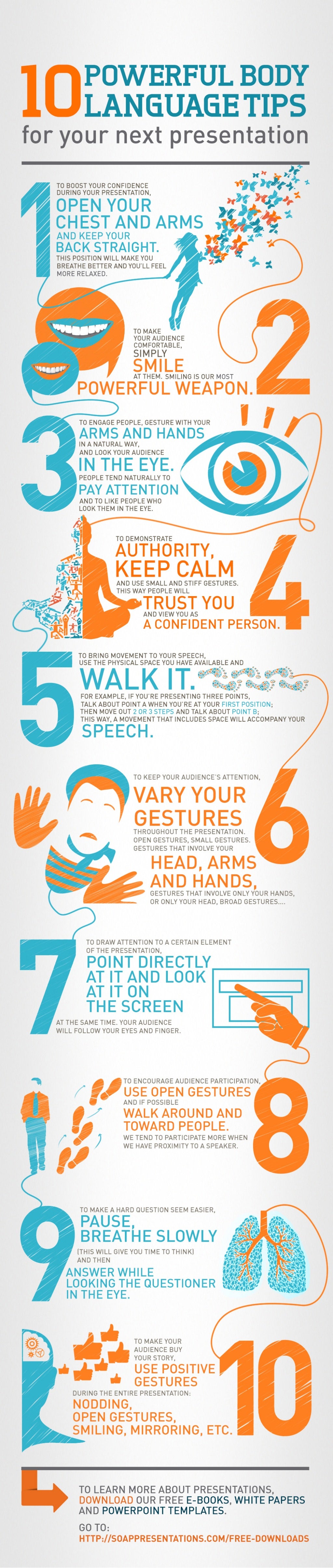
An infographic from SOAP Presentations lists 10 body language tips to employ during your next presentation. These tips range from how to get the audience to like you, to how to make sure the audience remembers your key points.

For example:

1. To get the audience to like you, make eye contact. People tend to pay more attention to and like those who look them in the eye.

2. To boost your confidence, open your chest and arms, and keep your back straight.

3. To demonstrate authority, be calm and use small, stiff gestures.

4. To draw the audience's attention to something, point directly at it and look at it yourself. The audience will follow your lead.

5. To convince the audience of something, use positive gestures — smiling, nodding, open movements, etc. — throughout the presentation.

Check out the full graphic for more:


Read more: http://www.entrepreneur.com/article/230253#ixzz2oNhquFjo

Saturday, December 14, 2013

Yes, it is marketing but this one is great!

Just enjoy and have a Merry Christmas!


Friday, December 13, 2013

If it’s in the hotel room, it's a souvenir, right?

by Theodore Koumelis

More than two in three (70%) of British travellers admit to taking something from a hotel following their stay, with toiletries being the most popular pilfered items. Three in five (59%) UK hoteliers report that their guests often take a variety of items when they leave. However, the TripBarometer Truth in Travel survey reveals several discrepancies between what travellers say they take, compared to what hoteliers report missing from hotel rooms once guests depart.

“Shampoo is one thing, but please stop taking the towels!”
Guests are more likely to admit taking items that are customarily thought of as complimentary such as toiletries or stationery. However it seems some travellers feel that even the towels, light bulbs and batteries they find in their rooms are free for the taking as well.

Despite less than one in ten (7%) of global travellers, and just one in twenty (5%) British travellers, saying they have taken towels from hotel rooms, an alarming one in four hoteliers report towels going missing following a guest’s stay.

Some travellers have peculiar ideas about what makes a good travel memento – one in ten hoteliers report clothes hangers going missing and 7% have found the batteries removed from TV remote controls after guests check out.

Items travellers admit taking from hotels vs. what hotels report having been taken:

“If it’s free, it’s for me”
When it comes to the key motivators for choosing an accommodation, travellers around the world love a freebie. Over the past year, traveller interest in complimentary amenities has gone up, reinforcing the idea that one of the best ways for hoteliers to entice guests is to offer free services as part of the daily rate.

More than two in three (68%) British travellers now expect the hotel they choose to have free in-room Wifi.

What amenities global travellers expect from their accommodation in 2013 vs. 2014: “It seems some of us Brits are prone to stretching the bounds of what is a legitimate hotel freebie, but we’re not alone. Travellers from around the world are apparently pilfering items such as towels and clothes hangers, with US hotels the most likely to report these items missing,” commented James Kay, TripAdvisor spokesperson.


See the full article here:

Tuesday, August 20, 2013

A switched-on hotel in Dubai

I found an interesting article about how to use modern technology in a good and consumer friendly way,

in Dubai, the ca new Hotel called "Vida Downtown" allows you to check in, order room service from your smartphone — even if you’re poolside.


From funky tables that turn into interactive touch screens to in-room tablets that double as hotel room keys and controls for lights and temperature, the era of Jetsons-esque travel is already here.

But let’s face it. Beyond a few nods of approval at the concierge, the novelty often quickly wears out. Or, if you aren’t really part of the gadget set, you probably have given up trying to figure out your room’s technological amenities.

One hotel in Dubai wants to change all that by giving you, the guest, the power to future-forward your hotel room right from your device — meaning your smartphone or tablet becomes the control board for all the stuff you need. You can order room service, book your laundry, buy gifts, speak to a concierge or pick up an e-newspaper, all from your device.

And all this without the need to ever download an app.

Read the full article by Gulf News here:
http://gulfnews.com/life-style/travel/destinations/a-switched-on-hotel-in-dubai-1.1220636